
Building Biotech — and Belonging — in St. Louis: BioGenerator Venture Fellows


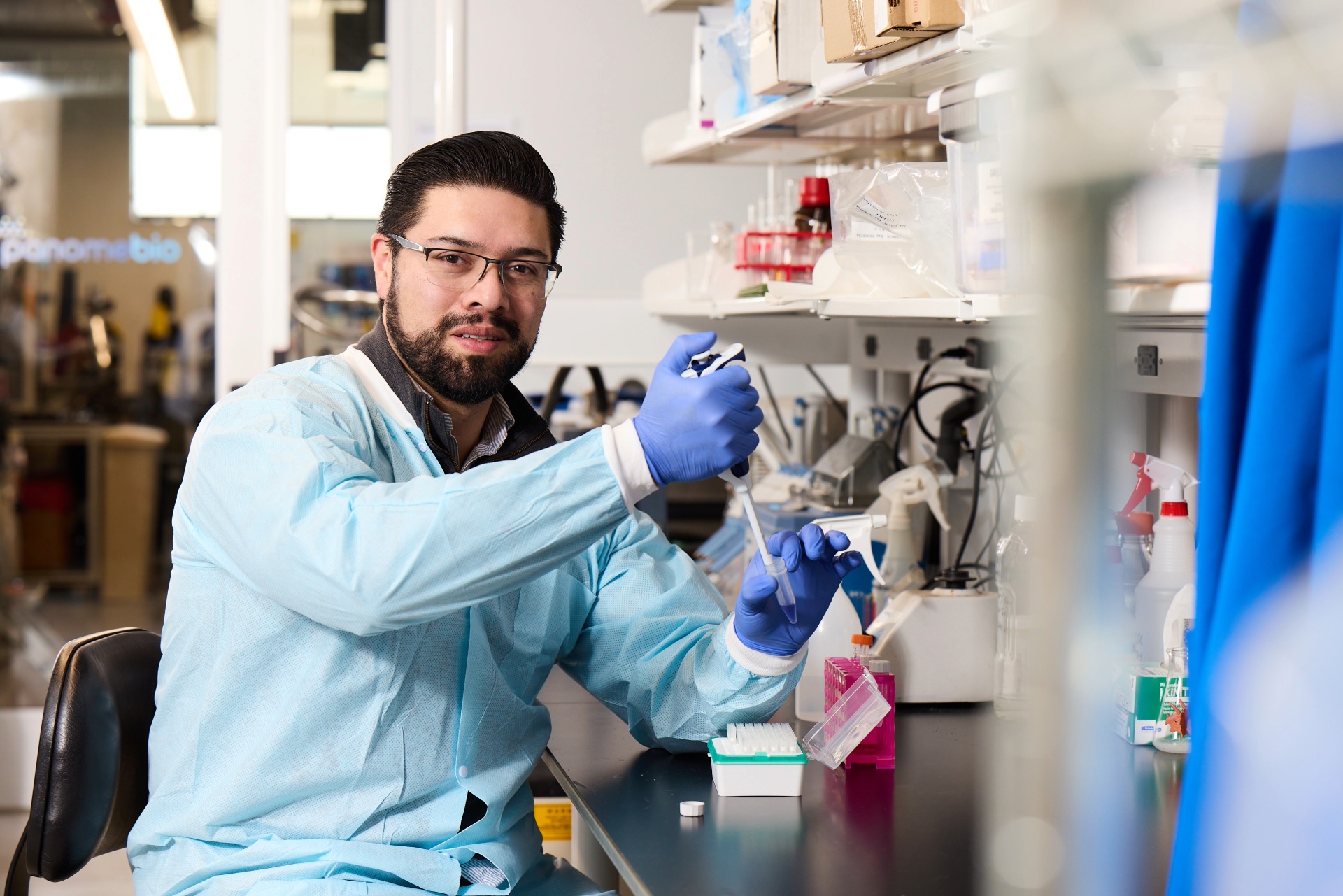
Guillermo Rivera-Gonzalez working in a lab.
Born and raised in Mexico City, Guillermo Rivera-Gonzalez received his PhD in the United Kingdom and eventually came to St. Louis to co-found biotech startup CapyBio. His company uses computational tools to improve the success rate of drug development.
“Something changed during COVID for me. Seeing the impact that Moderna and Pfizer had on producing the vaccine pretty quickly reminded me of why I got into science, how science can be helpful to people,” Rivera-Gonzalez said. “And the fact that we can use the knowledge that we have in the lab to generate something that will have a more direct impact on people, that’s what moved me to sticking it out with the company.”
Now Rivera-Gonzalez is one of two current BioGenerator Venture Fellows in a BioSTL program supported by JSMF that aims to cultivate diverse bioscience innovation leaders. The fellowships offer a combination of professional development, real-world experience, and venture capital to underrepresented entrepreneurs whose companies are solving important problems in healthcare and agriculture.
“In St. Louis, we want to make sure that the innovation economy is reflective of the diversity of our community,” Jim McCarter, Senior Managing Director of BioGenerator Ventures, said. “The entire success of St. Louis hinges on our ability to be an attractive destination for people from diverse backgrounds. And if we’re seen as exclusionary or not being a welcoming place, we won’t succeed as a metropolitan area.”

Venture Fellows are embedded within the BioGenerator team, which helps them build an understanding of entrepreneurship from an investor’s point-of-view. That placement allows the fellows to receive one-on-one training sessions from residents and hear from guest speakers visiting the BioGenerator, while also working through entrepreneurship curriculum from WashU. Pairing those practical experiences with capital opens the door for entrepreneurs to find a way to build their companies here in St. Louis.
“In addition to salary support that the fellows receive, they have proof-of-concept funding and diligence funding that they can apply those dollars to their startups,” McCarter said. “And that is really unusual, to have non-dilutive funding to help launch a company at the earliest stages.”
Rivera-Gonzalez had experienced deep uncertainty about his next professional move before finding out that he was accepted for the fellowship.
“It was a lot of pressure at the time,” Rivera-Gonzalez said. “Knowing that I was going to get help in understanding this whole new concept of entrepreneurship and company growth … that fact that I don’t have to do this alone, just knowing that we have that backing from people, that there is a community, just took a lot of the anxiety from starting this journey.”

Part of that community has been formed with the other Venture Fellow, Grant Downes. Downes is the co-founder and CEO of TrueBind Bio, a life science tools and services company trying to bring the world of miniproteins to the research and diagnostic space. Both Downes and Rivera-Gonzalez have been deeply involved in community outreach, from trying to stimulate interest in science for elementary school students and providing advice on high school capstone projects to working with postdoctoral researchers in St. Louis and the Midwest.
“There’s nothing better than being a person from an underrepresented background and seeing someone who is in the same area that you want to occupy,” Downes said. “I know that’s everything I looked for and wanted when I was growing up, but seldomly in the Midwest and in STEM in general, you don’t really see people that look like us.”
Downes was born in Kansas City, Missouri, to parents who immigrated to the US from Trinidad and Tobago in hopes of providing better opportunities for their children. As an avid decathlete, he spent time improving his athleticism across numerous track and field events, trying to become better than average at each skill and learning how to persist through to the end.
“I carried those themes with me into college, knowing that I wanted to do biomedical engineering,” Downes said. “I thought that if I could create something, I can impact millions of lives across the world.”
Now, thanks in part to the BioGenerator Venture Fellowships, he and Rivera-Gonzalez are better positioned to do just that.