
“The Hope Is in the Progress”: How Upward Mentoring Is Inspiring St. Louis’s Next Generation


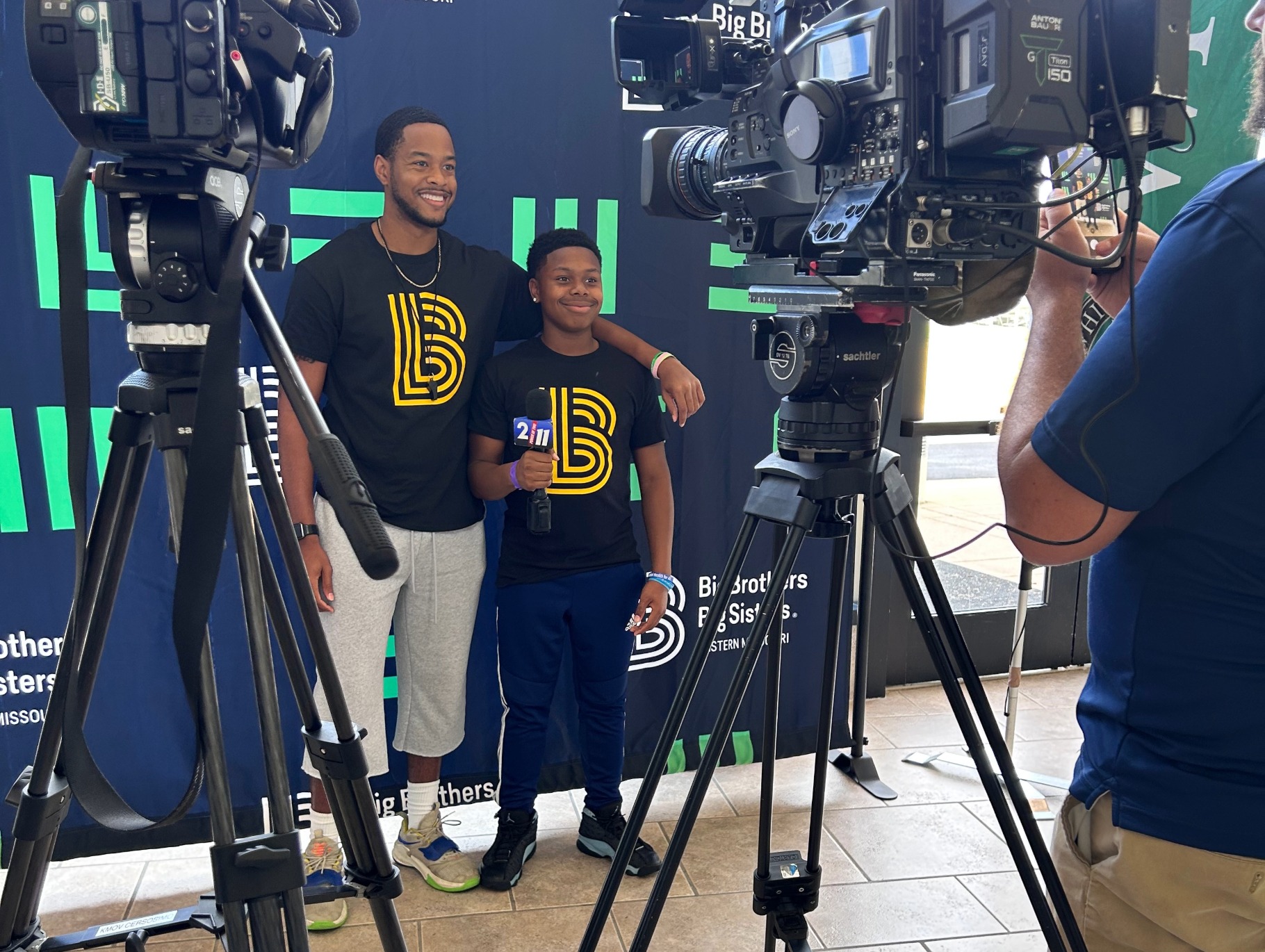
Upward Mentoring community-based mentor Kobe Griffin (left) and mentee Norwin.
Every day, a St. Louis youth calls his mentor Kobe Griffin, not because something is wrong, but just to catch up. For Griffin, a community-based mentor with Big Brothers Big Sisters of Eastern Missouri (BBBSEMO), that daily phone call about nothing in particular is everything. It’s evidence that the two have developed a deep connection that doesn’t rely on elaborate outings or one-off experiences, meaningful as those can be. Instead, on the other end of the line, the young mentee finds the steady, ordinary presence of an adult whom he knows isn’t going anywhere.
That daily investment is what sets BBBSEMO’s Upward Mentoring apart from traditional mentorship programs. Rather than relying on occasional volunteer visits, Upward Mentoring pairs preteen and teen boys with full-time, professional mentors who provide day-to-day support. Those relationships are supplemented by additional volunteer mentors who offer career guidance and exposure. The aim is to build long-term relationships and, over time, more young people who grow into champions for the next generation.
“When you invest in young boys or young people in general, you strengthen their families and schools and communities. You inspire the next generation and build a pipeline for youth to dream,” Jamal Bailey, BBBSEMO’s program director of innovative mentoring, said. “A mentor’s presence can help a young person think about school differently, think about behavior differently, think about relationships differently, think about their future differently.”
According to Bailey, the program focuses on both achievement and fun to help youth gain confidence and find a sense of belonging.

Griffin knew from experience that he wanted to nurture this new way of thinking. Previously, he worked at a juvenile justice center where he said he felt he couldn’t bring his full, upbeat self to his interactions with young people. Now, as a mentor with BBBSEMO, the more frequent and consistent time with his mentees allows him to model the character and accountability he once sought for himself.
“As a 25-year-old Black man in St. Louis, I wanted a mentor or a big brother that I didn’t have. I’m the oldest of four, so I was the big brother to three siblings, but I had no one to big brother me,” Griffin said. “You need a positive male figure to look up to.”
Griffin is clear-eyed about what makes the work successful. “Every outing won’t be the one that gets it done. Every conversation won’t be a heavy hitter about tough topics,” he said. “But being consistent [in] caring for the youth is what keeps the thing going, where you get those small wins. … People don’t forget how you made them feel.”
The research bears out just some of the benefits. A recent report by Big Brothers Big Sisters of America noted that mentored students attend school more regularly, perform better academically, and experience fewer behavioral problems than their peers.
The outings are less of a reward and more like raw material to build trust that can be drawn on later when needed most. Mentors take their mentees to St. Louis Battlehawks games, and on outdoor adventures like an upcoming hike at Elephant Rocks State Park. On one paintball excursion, Griffin and a fellow mentor debated whether to bring two mentees who attended the same high school and had been at odds with each other. Their solution was not only to bring them, but to put them on the same team. After working and winning together, the two mentees became close friends.
Other breakthroughs are quieter. Griffin helped one teen develop his literacy skills while supporting him through a successful job search. A job prospect, in turn, can increase a young person’s social capital while building their professional network. As Griffin said, “What you know is great, but who you know can serve you so much better.”
The depths of these relationships often show up most in moments no one plans. Last year, when the film Soul On Fire (based on the life of motivational speaker and BBBSEMO board member John O’Leary, who persevered after surviving a severe burn accident as a child) premiered in St. Louis, Griffin’s mentee Norwin was chosen to be a red-carpet reporter, interviewing actors and O’Leary himself.
During the screening, Norwin got emotional. He told Griffin that when he had been in the hospital as a boy, like O’Leary, only his mom had come to visit. Griffin told him that’s why he’s here now – to be in Norwin’s corner at any stage in his life.
“This isn’t just a job I have. This is a brotherhood,” Griffin said about the moment of vulnerability with his mentee. “And hopefully when I get super old, we’re still cool enough that [he’ll] come check on me and see how I’m doing.”

That brotherhood is designed to renew itself and outlast any single mentor. As mentees reach their own milestones, some return as peer mentors, passing on what they learned. The clearest proof of that cycle may be Bailey, the program director himself. He grew up needing the very thing he now spends his days providing.
“It’s been my life’s work. I’m trying to figure out how to inspire more kids like myself,” Bailey said. “It’s really just understanding that ‘to whom much is given, much is required,’ and when you’re in a situation to give it back, you have to. … I don’t feel like I’m working at all because it’s something that I would do for free.”
There are around 50 youth currently in the Upward Mentoring program. Bailey’s goal is to expand to 100 mentees and beyond within a few years. As for Griffin, he sees hope in the progress made by his mentees, and he looks forward to watching five of them graduate high school over the next three years.
“We have to keep trying, you have to keep pushing. Because no one gave up on me,” Griffin said. “That’s the biggest thing that I realized — my parents, my grandparents, my coaches never gave up on me. And we can’t give up on anybody, especially these young men.”
Norwin is one of around 50 youth currently in the Upward Mentoring program, though Bailey, the program director, said the goal is to expand to 100 mentees and beyond within a few years.
“It’s been my life’s work. I’m trying to figure out how to inspire more kids like myself,” Bailey said. “It’s really just understanding that ‘to whom much is given, much is required’ and when you’re in a situation to give it back, you have to. … I don’t feel like I’m working at all because it’s something that I would do for free.”
As for Griffin, he sees hope in the progress made by his mentees, and he looks forward to seeing five of them graduate high school over the next three years.
“We have to keep trying, you have to keep pushing. Because no one gave up on me,” Griffin said. “That’s the biggest thing that I realized — my parents, my grandparents, my coaches never gave up on me. And we can’t give up on anybody, especially these young men.”