
Six Takeaways from the East-West Gateway Council Panel Discussion on Emerging Regional Initiatives in St. Louis


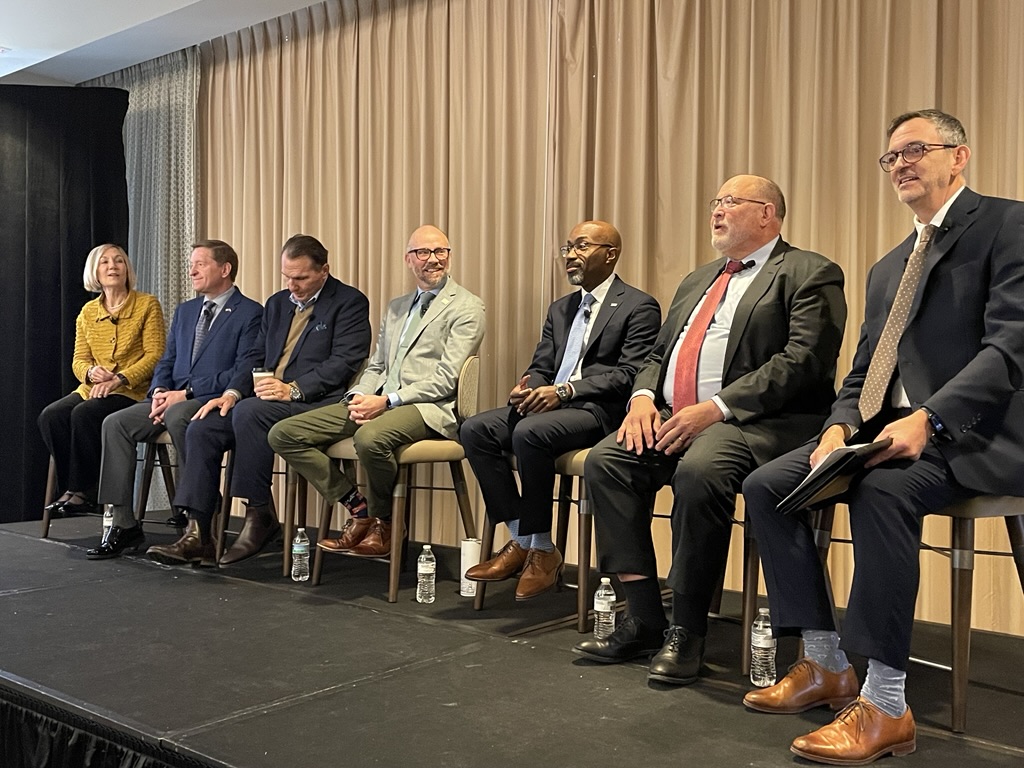
Karen Branding, Brad Dean, Ron Kitchens, Ryan McClure, Jason Purnell, Jim Wild, and moderator Casey Nolen during a panel discussion on emerging regional initiatives in St. Louis.
Jason Purnell, JSMF President and CEO, joined fellow St. Louis leaders on a panel hosted by the East-West Gateway Council of Governments to discuss emerging regional initiatives and the collaboration among their organizations. Other speakers included Karen Branding of the Regional Business Council; Brad Dean of Explore St. Louis; Ron Kitchens of Greater St. Louis, Inc.; Ryan McClure of Gateway Arch Park Foundation; and Jim Wild of East-West Gateway.
Here are some key takeaways on the collaborative regional efforts that aim to move St. Louis forward.
1. $40 billion in investment is coming to the region by the mid-2030s
With the airport renovation, the Interstate 70 widening project, new hospitals and entertainment districts, Boeing’s facility expansion, and more, the St. Louis region is poised to see roughly $40 billion in capital investments over the next few years. As Karen Branding suggested, these projects present an opportunity for regional growth, but they also require a trained workforce to capture it. Branding added that there is a responsibility to ensure that St. Louisans who are unemployed or underemployed today can access the education, training, and pathways needed to find an on-ramp to these new jobs.
2. We have to sell the region as a whole
Brad Dean shared that more than 25 million people will visit the region this year, and that these travelers don’t care where city, county, or state lines fall. They see the Mississippi River as connecting the two sides rather than dividing them. As a result, we need to collaborate across these borders to share the entire region’s assets, and Dean shared that Explore St. Louis is investing time and talent into defining a regional brand identity that capitalizes on those qualities.
3. “A rising tide doesn’t lift all boats.”
If we don’t invest appropriately, our region can’t get ahead. Ron Kitchens illustrated this with the story of a boat tied to a dock with four lines: three that are brand new and one that’s been neglected. Eventually, a rising tide that lifts all the other boats on the water will cause this one to sink because of the rope that hasn’t been invested in. Ultimately, we need to invest in the people of St. Louis so they can benefit from that rising tide.
Jason Purnell added to the analogy that we have to confront the fact that some St. Louisans don’t have a “boat” to begin with when considering how we invest in opportunities for people.
4. Collaboration means knowing what you’re good at and partnering for the rest
Gateway Arch Park Foundation is advancing multiple regional initiatives to enhance downtown St. Louis, including reimagining the riverfront, redeveloping the former Millennium Hotel site, and potentially expanding the park into East St. Louis, which was part of architect Eero Saarinen’s original design for the Gateway Arch. Ryan McClure explained that these collaborative efforts involved thinking about what’s best for St. Louis and this community rather than what’s best for individual organizations.
5. Inclusion is not the enemy of growth
Jason Purnell emphasized that inclusive growth is a strong economic strategy, saying that a region that works for its most vulnerable residents works for everyone. He described how the Inclusive Prosperity Partnership brings together regional leaders and community members to co-design solutions to the region’s challenges. IPP work goes beyond good intentions — it’s supported by dedicated funds, staff, data, and infrastructure to ensure that collaboration has a lasting impact.
6. The region’s main gap is a shared vision
East-West Gateway Council of Governments and Greater St. Louis, Inc., are collaborating on a new initiative called Next Move, St. Louis that aims to unite the civic sector around a shared vision, which Jim Wild said emerged from conversations about what is holding the region back. Landing on where we’re headed, and why, is a critical step. But a vision alone won’t move the region forward. Sustained alignment around a mutual North Star, and the shared work of turning that vision into action rather than working in silos, will be critical to ensuring a growing and thriving St. Louis region.
Want to dive deeper? Watch a recording of the full discussion on YouTube.